This report builds on earlier work related to the Gap Analysis, and explores the next steps required to ensure rural community engagement is actioned. This is followed by recommendations on prioritizing community voices through trusted community-driven organizations, which will ultimately help support a more responsive, accountable, and community-aligned rural healthcare system in British Columbia.
This report presents findings from a pan-provincial study on rural patient experiences and costs to relocate to Vancouver for a solid organ transplant, with evidence-based recommendations for reducing health disparities and promoting health equity for rural populations.
Click on the infographic to the right to see it larger!
This report aims to understand and document an innovative model of employing Internationally Trained Health Professionals as Cross-Cultural Health Brokers (CCHBs) to meet the health care needs of community members. The results of this study will add to the existing data and evidence, so that existing resources can be better used to meet the health needs of newcomers to Canada in a cost-effective way.
A report that considers evidence on the mechanisms, processes and outcomes of a commitment to community engagement in health planning and delivery, in the context of findings from qualitative research interviews which sought to understand how CHCs are meeting their goal of being community-directed.
Click on the infographic to the right to see it larger!
This report aims to better understand and document an innovative model of employing Internationally Trained Health Professionals as Cross-Cultural Health Brokers (CCHBs) to provide culturally competent and appropriate care to immigrants, refugees, and newcomers to Canada at the Umbrella Multicultural Health Co-op (UMHC). This is followed by recommendations for next steps and further inquiry.
A summary report of the findings from a study adapting and developing a peer support framework to support perinatal mental health for rural citizens. Development of the framework was conducted in collaboration with a community-based advisory committee and eventually was implemented with a PDA pilot group. Both the committee and PDA pilot group provided feedback to help evaluate the pilot project.
A summary report of findings from a provincial survey to understand rural British Columbia communities’ experiences and responses to the COVID-19 pandemic.
A summary report of findings from a provincial survey to understand rural British Columbia communities’ experiences and responses to the COVID-19 pandemic.
A scoping review of the international literature to understand the structure, function and impact of rural health councils on health care planning, decision-making and delivery activities.
A scoping review of the international evidence, exploring community-level factors and strategies to facilitate and improve the recruitment and retention of health care providers to rural and remote areas. This review was conducted through the Rural Evidence Review project.
The North Island Project: Building Blocks for Sustainable Rural Maternity Care Annual Report – July 2018
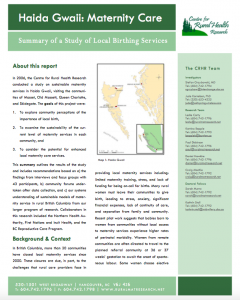
A report documenting findings from the Haida Gwaii phase of the “Logic Model Project,” a study was undertaken to develop evidence for supporting sustainable rural maternity care. There are currently no maternity services in Masset and maternity services without caesarean section backup in Queen Charlotte city.
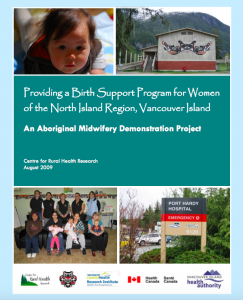
Providing a Birth Support Program for Women of the North Island Region, Vancouver Island: An Aboriginal Midwifery Demonstration Project– August 2009
A consultation report on the potential for the implementation of an Aboriginal Midwifery Demonstration Project in the North Island region, commissioned by First Nations and Inuit Health (FNIH, Health Canada).
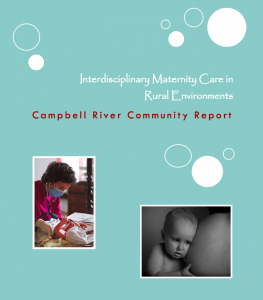
Interdisciplinary Maternity Care in Rural Environments: Campbell River Community Report – December 2009
A report from the “Interprofessional Collaborative Maternity Care Project” looking at Campbell River, BC and local barriers to models of midwifery care in the community.
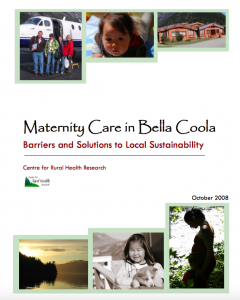
Maternity Care in Bella Coola: Barriers and Solutions to Local Sustainability – October 2008
A report documenting findings from the Bella Coola phase of the “Logic Model Project,” a study undertaken to develop evidence for supporting sustainable rural maternity care. There is currently a moratorium on intrapartum services in Bella Coola.
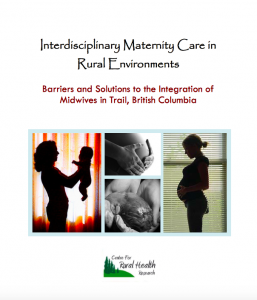
Interdisciplinary Maternity Care in Rural Environments: Barriers and Solutions to the Integration of Midwives in Trail, British Columbia – July 2008
A report from the “Inter-professional Collaborative Maternity Care Project” looking at Trail, BC and local barriers to models of midwifery care in the community.
Bella Bella/Waglisla: A Case Study on the Implications of Closure of Local Maternity Services – August 2007
A report on the socio-cultural, financial, and health impacts on Bella Bella/Waglisla women of closures of local maternity services.
Rural Women’s Experiences of Maternity Care: Implications for Policy and Practice – July 2005
This Status of Women Canada Report investigated rural maternity care from the perspective of parturient women, care providers, health care administrators and local leaders. It was found that women’s experiences were bound in the complexity of relationships that were influenced by the attitudes and actions of care providers and the organization of health system services. The lack of clearly defined policies supporting rural maternity care was reflected in a tenuous infrastructure for local birthing. Literature on risk assessment provides a lens through which some of the findings may be interpreted.